|
|
|
Applications>> |
|
Quantum Information Science and Lasers |
|
|
|
1. Introduction to Quantum Information
Science |
|
Quantum information science is an interdisciplinary cutting-edge
discipline that integrates quantum mechanics with informatics. It studies the
quantum properties of microscopic particles and their applications, mainly
exploring the innovative applications of quantum mechanics in fields including
information, materials and energy.
It is grounded in quantum mechanics, driving groundbreaking advances in
computing, communication and sensing by exploiting unique quantum phenomena
including quantum superposition, entanglement, wave-particle duality,
Heisenberg’s uncertainty principle, quantum leap and quantization.
In recent years, quantum information science has presented new opportunities and
challenges to classical information science. Quantum coherence and entanglement
have opened up promising prospects for computational science. In turn, the
emergence and development of quantum information science have greatly enriched
the connotation of quantum theory, deepened the understanding of fundamental
quantum mechanical principles, and further verified the scientific validity of
quantum theory.
Lasers are widely used in the quantum field, thanks to their high coherence,
exceptional brightness, and precisely controllable properties—making them a
cornerstone tool for both quantum scientific research and technological
development. |
|
2. Applications of lasers in the quantum
field
|
|
Laser and Quantum
Computing
Quantum computing leverages the parallel
computing capability of qubits to solve complex problems such as
cryptanalysis and molecular simulations for drug discovery, which are
intractable for classical computers. Ion-trap quantum computing: Lasers
are employed to cool and trap ions like Ca⁺ and Yb⁺, and tailored laser
pulses manipulate the electronic states of ions to realize qubit
initialization, logic gate operation and state readout.
Superconducting qubits: Lasers can assist the fabrication of
superconducting circuits such as Josephson junctions, and can also be
applied to read out the state of superconducting qubits via optical
coupling.

Quantum Computing for Laser Vector Matrix Multiplication
Laser and Quantum Communication
Based on the principles of quantum entanglement and the
no-cloning theorem, Quantum Key Distribution (QKD) technology enables
the creation of unconditionally secure communication networks. China’s
“Micius” satellite has already achieved quantum key distribution over
distances of up to 1,000 kilometers.
Quantum Key Distribution (QKD): Lasers generate single photons or
entangled photon pairs—typically in the 1550nm communication wavelength band—and
transmit quantum keys via fiber optics or free space. China’s “Micius” satellite
has successfully demonstrated 1,200-kilometer quantum key distribution using
laser technology.
Entangled photon source: Entangled photon pairs are generated via
spontaneous parametric down-conversion (SPDC) or quantum-dot lasers, enabling
applications such as quantum teleportation and Bell tests.

China's "Micius" Satellite
Laser and Quantum Simulation
Quantum simulation involves using quantum systems to
model the behavior of other complex quantum systems.
Cold atom systems: Laser cooling—such as 780nm laser cooling of
rubidium atoms in a magneto-optical trap—reduces atomic temperatures down to
microkelvin levels, enabling the creation of Bose-Einstein condensates (BECs)
and providing a platform to study quantum phenomena observed in condensed matter
physics, including superfluidity and quantum phase transitions.
Optical Lattice: Lasers create a periodic potential field (e.g.,
using a 1064 nm laser), trapping ultracold atoms to simulate the Hubbard model
and investigate the mechanism behind high-temperature superconductivity.

Quantum simulation cracks high-temperature superconductivity
Laser and Quantum Sensing
By leveraging precise quantum-state measurements, the
sensitivity of devices such as gravimeters and atomic clocks can be
significantly enhanced, enabling applications in geological exploration
and advanced navigation systems—such as quantum gyroscopes, which offer
precision up to 1,000 times greater than traditional technologies.
Atomic clocks: Laser-cooled atoms (such as strontium atomic clocks) are used to
probe their ultrafine energy-level transitions, pushing timekeeping precision up
to 10-19
Magnitude levels (such as NIST's aluminum-ion optical clock).
Quantum Gyroscope: Leveraging the Sagnac effect—achieved by using
lasers to manipulate cold atoms—to enable high-precision inertial measurements
(e.g., for defense and navigation applications).
Gravitational Wave Detection: Laser
interferometers, such as LIGO, reduce noise and enhance detection sensitivity by
using quantum-squeezed light. Quantum optics and fundamental research.

Atomic Clocks and Time-Frequency Technology
Laser and Cavity Quantum Electrodynamics (QED)
Laser coupling with optical microcavities to study strong
photon-atom interactions, such as realizing the Jaynes-Cummings model.
Single-photon sources and detectors: Quantum dots or diamond NV
centers are excited by lasers to generate deterministic single photons, enabling
the construction of quantum networks.

Building a Diamond NV Center Quantum Network
Laser and Quantum Materials
Researching quantum-effect materials such as
superconductors and topological insulators to advance innovations in
energy storage (e.g., high-temperature superconducting cables) and
electronic devices (e.g., low-power chips). Additionally, exploring
quantum state control in materials science.
Topological quantum materials: Femtosecond laser manipulation of
electronic states in topological insulators (such as Bi₂Se₃), exploring the
quantum spin Hall effect.
Ultrafast quantum dynamics: Attosecond laser pulses (such as
those in the XUV range) are used to observe the quantum tunneling of electrons
within molecules.

Femtosecond laser pulses excite ferromagnetic/non-magnetic
heterostructures |
|
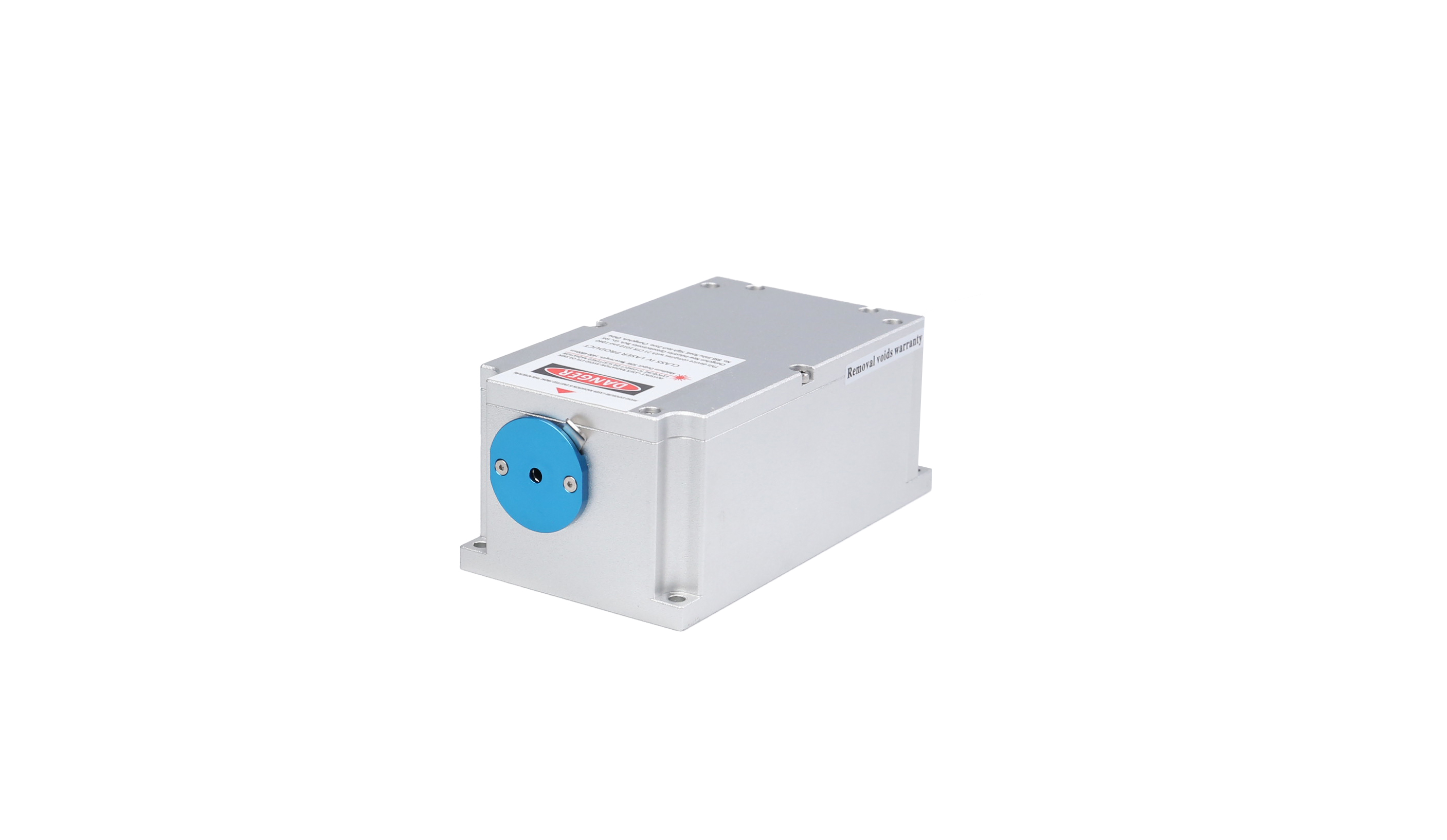
The primary lasers used in the quantum field |
|
Laser applications in the quantum realm demand extremely stringent parameter
specifications, with the core requirements summarized as follows: precise
wavelength, narrow linewidth, high stability, and low noise. The actual
parameters must be meticulously tailored based on the specific energy-level
structure and coherence times of the target quantum system—whether it involves
atoms, ions, solid-state defects, or other platforms. Commonly used wavelengths
include 193 nm, 266 nm, 313 nm, 355 nm, 405 nm, 488 nm, 520 nm, 532 nm, 637 nm,
671 nm, 698 nm, 780 nm, 852 nm, 1064 nm, and 1550 nm. Key performance metrics
include wavelength stability < 100 kHz, linewidth ranging from 1 kHz to tens of
MHz, rms noise <0.1%,TEM00
, M² <1.1, and beam spot stability within 1 μrad. |
|
|
|
|
|
|
|